18 min read
What to do When it All Goes Sideways: The Ingrown Hair Removal

I had a hobby once, you know? Had, as in not anymore, and I don’t miss it one bit. Every free moment I got, I would get my tools and start picking. Pretzeled into yoga shapes (I never knew I was capable of) in front of a magnifying mirror (got myself one of those with an adjustable hand because I was really passionate), metallic pink tweezers in hand, regretting that human eyes have no zoom function, and engaged in what can only be described as a dermatological excavation project. I was trying to get to the root (there will be more than one lame joke throughout this, so those who enter would be wise to leave all hope at the door) of the ingrown hair problem. One follicle at a time. I had it bad, especially in the bikini area, while legs and armpits not so much (of course, why would they be on an easily accessible area, this would be too simple in the great scheme of suffering). Btw, I have since stopped shaving my nether regions, but we’ll get to that.
This got me thinking that, of all the infinite moving parts and strange rebellions our amazing body can stage, an ingrown hair has to be one of the pettiest, silliest ways to torture the owner of that body. Sure, you get sick, and your body fights the foreign invader, or you get a cut due to a slip of a tool while building, fixing, or cooking something. I get this, this has a point. But a hair, burrowing into my flesh and ruining my week? Come on! A hair! Don’t get me wrong. I love hair where it’s supposed to be, and I really, really, really love hairy men. Like properly 70-s, no manscaping hairy, but am baffled by the potential of these keratinose little wretches to destroy the bikini season.
Hair is a pretty common occurrence on this planet and on our bodies, so we must take the sheer number of them as a sign that something could go wrong. We, humans, will grow about five million hairs and about 590 miles of them over our lifetime; some wanted, others not so much, but still mostly poking through the skin in orderly fashion, without any special drama. Then, a single hair decides that instead of growing upward like a respectable member of this hairy society, it will make a U-turn and tunnel back into the skin.
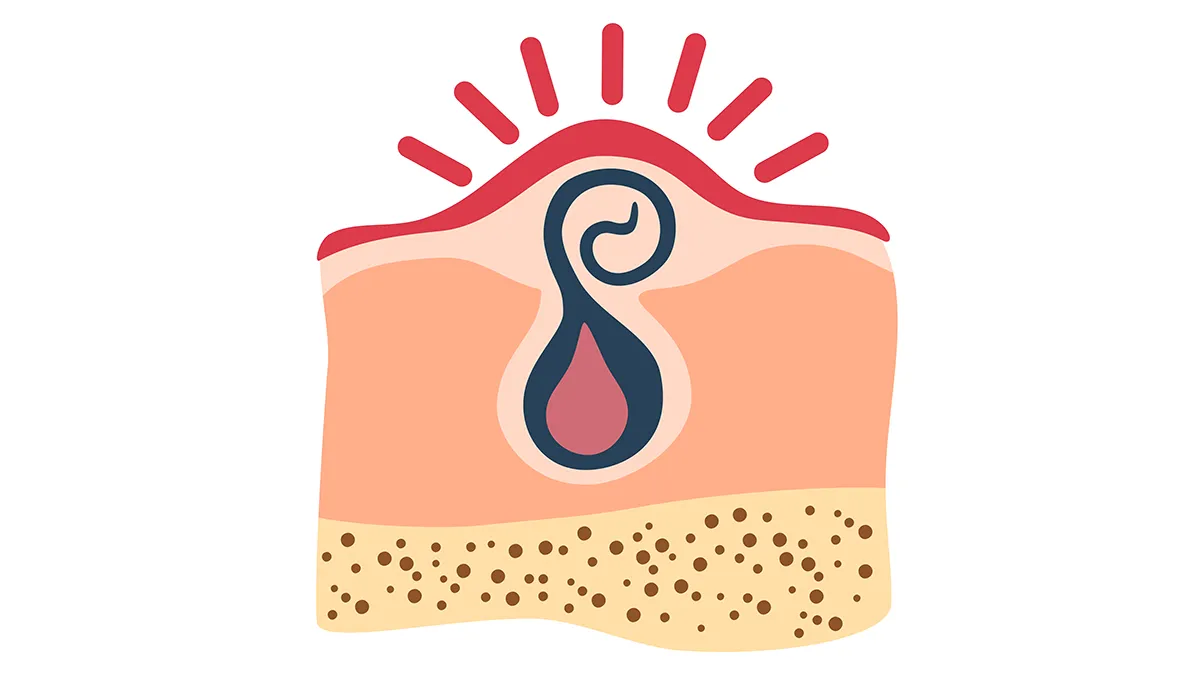
Ingrown hairs are incredibly common and persistent. You didn’t do anything wrong. I’m sure Beyoncé had her fair share, too… all genders, skin types, ages, and pay grades get them, especially if you have coarse curly hair in areas that you frequently remove hair from. You’ve been here long enough to know that most ingrown hairs resolve on their own; there is no special ingrown hair at-home treatment needed for the vast majority of the insignificant ones. But every once in a while, you’ll get this painful, throbbing, inflamed, infected hair boil, stubborn enough to contemplate surgery at 1 AM, after you’ve been picking that spot (probably infecting it more) for the past half an hour, unable to fall asleep. May she, who had not enjoyed the satisfaction of a good dig out, throw the first tweezer.
The good news is that most ingrown hair removal can be handled safely at home, provided you keep it clean, know what you're doing, and resist the deeply human urge to attack and mangle it. Maybe you’re even hoping for that satisfying pop if you’ve got a bit of a puss pocket action going on there. I understand the temptation and have not always been able to resist when I was tired, and my frontal lobe waved the white flag, forfeiting the game to base impulses.
There are few things in this life more strangely satisfying than finally freeing a trapped hair that’s been driving you insane. The feeling lives somewhere between popping bubble wrap and untangling two necklace chains that seem irreversibly tangled. But before we get to the unfortunate (but oddly addictive world) of ingrown hair removal and the biochemistry of these little wins, let's start with the basics: what an ingrown hair actually is, what causes it, what it looks like, and most importantly, how to get rid of an ingrown hair without accidentally turning a small, barely noticeable spot into an infected dumpster fire that can have its own reality show (Had one of those, I called him Harrold).
What Is an Ingrown Hair?
An ingrown hair occurs when a hair grows back into the skin instead of poking through the follicle opening on the skin and continuing outward as the universe had planned for it, but some hairs decide to denounce their destinies.
The humble hair structure is actually quite interesting and more sophisticated than you'd expect. The hair root passes through the epidermal and dermal layers down to the subcutaneous layer. The root extends upwards into a hair shaft, which is the part of the hair you'll see sticking above the skin surface and is mostly made of keratin.

The bulb at the root produces hair and is surrounded by a blood-vessel-packed dermal papillae that provide oxygen, while above the papillae, a hair matrix produces new hairs and protects the hair's pigment. Getting a gray hair means that melanocyte stem cells that supply pigment to the growing hair matrix have stopped working.
As the hair grows, it will be guided by the inner and outer root sheaths. Ideally, this will get the hair shaft through the surface in a straight line. Each hair also has some extra equipment, like a sebaceous gland that lubricates it and the arrector pili smooth muscle, attached to the follicle, that can pull upright and give you goose bumps if exposed to cold, fear, or extreme pleasure.
Normally, a hair grows from the follicle, passes through the surface of the skin, and all is fine and dandy. Sometimes, however, the tip becomes trapped beneath the surface. It may curl sideways, loop back into the skin, or become blocked by accumulated dead skin cells (which is why you get less ingrown hair if you exfoliate regularly).
If things go sideways rather than straight up and the hair gets trapped like a young couple at a nosy family dinner, the body interprets it as a foreign object. We’re very good at dealing with foreign objects and quick to launch an inflammatory response to resolve the situationship. This inflammation is why you see a classic hair bump: a raised, red, sometimes itchy or really painful pimple-like structure, which may or may not evolve into a hair cyst, a bumpier, redder, more inflamed version of an ingrown hair.
Dermatologists often classify ingrown hairs as a form of folliculitis, which simply means inflammation (every "–itis" is an inflammation) of the hair follicle due to an ingrown hair. This is not unusual because your immune system is doing exactly what it was designed to do: reacting to something it thinks shouldn't be there to protect you from opportunistic invaders or foreign objects. You’ve probably had some ingrown hairs that were just calmly growing under the skin, too. Not every ingrown hair will get infected, and the non-infected ones are better candidates for a tweezers pull.
How to Recognize an Ingrown Hair?
If you're not really sure what you’re looking at on your skin and are wondering what does an ingrown hair look like, this depends on how long the hair’s been trapped and how inflamed the area has become. You may have an entirely flat surface with no inflammation and a very long hair coiled below, or a short stub that’s causing all sorts of trouble.
Common signs of an ingrown hair include:
- A small red bump or cluster of bumps
- A visible loop or dark line under the skin
- Itching or tenderness
- Mild swelling
- A pustule that resembles acne
- Localized pain when touched
What is a deep ingrown hair?
Well, this one may be a bit more difficult to sniff out because the trapped hair isn't visible. It’s a bit deeper in, further from the surface. You may notice a firm, tender nodule beneath the skin that stays put for weeks. These deeper ones are sometimes also called a hair cyst or a hair boil, though true cysts and boils involve different biological processes to grow their nodules.
One clue that you're really dealing with an ingrown hair is location, aka you’ll mostly find ingrown hair in locations that you regularly remove hair from, like:
- Beard
- Neck
- Underarms
- Legs
- Bikini line
- Pubic area
- Chest
What Causes Ingrown Hairs?
An ingrown hair is a victim of circumstance, most commonly orchestrated by a hair follicle blockage. Since it’s an opening, any opening can be blocked with enough material. It’s purely a scale thing.
Just like a liver or a heart, the skin is an alive organ, and, like other organs, it can repair and rebuild itself (a process that greatly slows down as we age). As the skin naturally renews itself, new cells surface and old ones accumulate on the surface. These elders will slough off naturally in time, but this can be expedited by exfoliating on a consistent-ish schedule. If the cells fail to get out of the way and enough dead skin cells block hair follicles, the emerging hair may get stuck and curl sideways beneath the skin or downwards .
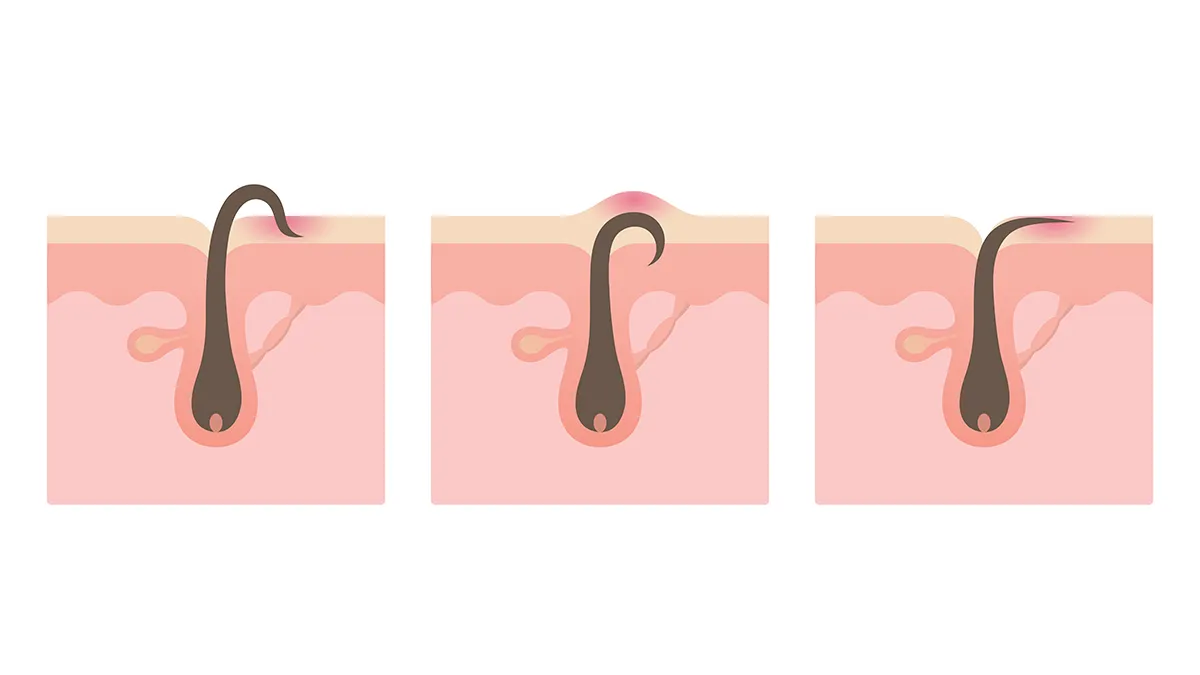
But it’s not just the clog problem. Hair structure really matters too. People with tightly curled or coarse hair experience significantly more ingrown hairs than those with straight, soft, or thin hair. This is because the natural curve of the curly hair shaft makes it more likely for the tip to bend back toward the skin. This is why curly hair ingrown problems are especially common in the genital region, bikini line, and underarms.
Several common habits we do can increase the risk of getting an ingrown hair:
- Stretching the skin while shaving (especially in areas that will rub together afterward)
- Shaving against the grain (sure, a smoother final surface, but not good from the position of the skin)
- Dull razor blades (uuugh, that’s a proper sin, scraping at your skin with an old, dull blade; get a new one, especially for sensitive areas)
- Too frequent waxing
- Tight clothing creates friction (if it’s so tight that it hinders hair growth, that’s too tight)
- Picking at bumps (but we do love it)
- Skipping exfoliation (this is probably one of the easiest changes you can do, running an exfoliator glove over your body while in the shower)
Interestingly, the body's inflammatory first aid response can worsen the problem rather than solve it. Once a follicle is already irritated, swelling may further trap the hair, creating a self-perpetuating cycle, a personal tiny hell. This perpetual motion machine is partly why what was a tiny, barely visible razor bump can linger for weeks and feed its own inflammation, despite containing a hair only a few millimeters long. And we love to pull these out with gusto, don’t we? It’s such a feeling of a win that you can surf on this satisfaction the whole day. Seems strange given that we’ve just caused ourselves some pain, but we also feel like we’ve solved a problem. But what does psychology say about this?
Why Is Pulling Out Ingrown Hairs So Satisfying?
Because humans are weird, but for a practical evolutionary reason. We may be living in 2026, but our bodies and brains are operating on old software that got us out of the trees and through the caves.
Anyone who has successfully extracted a long trapped hair knows the feeling of relief and supremacy of the self over an unworthy enemy. It’s even better if the hair is impossibly long, as this adds something to the win. The satisfaction comes from real psychological mechanisms.
First, humans are wired to resolve incomplete patterns. This is who we are, this is why a single tile out of place can drive us mad. Psychologists call this the Zeigarnik Effect: unfinished tasks occupy much more mental space than completed ones. The appointment you keep avoiding, or an obvious problem you’re ignoring, is the one you’ll think about most. A visible trapped hair is one of those unfinished tasks your brain desperately wants to solve, as it represents a disturbance in a regular pattern.
Second, there's immediate visual feedback and instant gratification. You see the problem. You act, you remove the problem. The result is obvious and easily attained. In most other life situations, a problem is more complex and needs much more effort to solve than a single tweeze. Your dopamine system appreciates this wham-bam level of efficiency because conservation of energy was key when food was scarce, so all calories counted for survival.
Finally, there's relief. The pressure, irritation, and inflammation often improve once the trapped hair is released, but keep in mind that just because it feels good doesn't mean every ingrown hair should be plucked. If you try to pick a really inflamed one, you can make the inflammation worse and inadvertently create a larger problem.
How to Safely Remove an Ingrown Hair?
How to remove ingrown hair or how to get rid of ingrown hair? This is the centerpiece of what we’re here to learn today. Sometimes tweezers are an appropriate choice, but not always. The safest approach, if you’re not sure, looks more like skincare than surgery.
Step 1: Soften the Area
Use a warm compress on the area for 10–15 minutes. Heat increases circulation and softens the skin, helping the trapped hair move closer to the surface. This is often enough for a mild ingrown hair at-home treatment, or if you can see it very close to the surface.
Step 2: Gentle Exfoliation
Use a soft washcloth, chemical exfoliant containing salicylic acid, glycolic acid, or lactic acid. These will sort of dissolve the "glue" holding the clumped dead skin cells together and will unblock the follicle. If you had some aggressive scrubbing in mind, don’t do it over an inflamed ingrown hair. Chemical exfoliants often outperform scrubbing because they remove the problem without creating additional irritation in an already compromised area.

Step 3: Release & Let It Be
If the hair becomes visible, you may gently lift the tip with a sterile needle or tweezers (please sterilize the tools you use, whether with boiling water, alcohol, or fire). And notice that we said to lift the hair, not pluck it. Dermatologists generally recommend freeing the trapped end and letting the hair grow out rather than fully removing the hair whenever possible on an infected spot. This will prevent you from causing further damage, and you can always pluck later once the inflammation subsides. So, the last rule is – Just leave it be. It takes superhuman self-control to do that, but it’s the best.
When NOT to Remove an Ingrown Hair Yourself?
We do love us some DIY ingrown hair removal on a boring Sunday afternoon. But there are some no-nos we should not try to solve ourselves, and which need to be looked at by a dermatologist or a skincare professional. I know that in our busy lives it seems silly to visit the doctor for a hair, but remember the roots go way down and are attached to blood vessels, sebum glands, and tiny muscles. Please, be wise (-er than me) and don’t try extracting ingrown hair if:
- The area is very painful and warmer than the surrounding skin
- Significant swelling is present and is getting worse
- Pus is draining out of the spot
- Large nodules form, and scarring develops
- You suspect (or are 100% sure of an) infection
- You have diabetes and/or impaired wound healing
- The lesion appears cyst-like, more than a clump of hair
If the infection seems to be worsening, a doctor may recommend topical antibiotics, oral antibiotics, topical retinoids, corticosteroid creams, and professional extraction.
Most of us will never, or very rarely, have such a serious ingrown hair that it requires medical attention, but frequent ingrown hairs that become infected can indicate chronic folliculitis, issues with your hair removal technique, or simply a hair type that is ideal for a laser permanent hair reduction. Life is hard enough without constantly risking unnecessary infection.
How to Prevent Ingrown Hairs?
As we all know, prevention is much, much superior to treatment, and an ounce of it can beat pounds of cures on any day. If we were all the responsible adults we pretend to be, we’d adopt the idea that the best ingrown-hair self-care strategy is to prevent them entirely. Is it possible? Sure. It may not mean you’ll never ever get a single ingrown hair in your life. No one can guarantee that, but we can guarantee that these hair bumps will be a rare oddity.
Exfoliate
We’ve mentioned this briefly above. Studies have shown that keratolytic agents such as salicylic acid and glycolic acid help prevent pseudofolliculitis and ingrown hairs by improving follicular turnover.
Moisturize
Healthy skin with enough moisture and a robust skin barrier sheds more, while dehydrated skin loves to accumulate rough patches that can trap hairs until kingdom come. Make this a routine to amply hydrate after you’ve exfoliated, your skin will have a healthy glow and be much less prone to setting traps.
Shaving Tips
- Always use a sharp blade
- Shave with the grain
- Avoid multiple passes over a single area if possible
- Don't stretch the skin, especially if you’re also going against the grain
- Use some form of lubrication (shaving cream, a gentle soap, coconut oil…)
Wear Looser Clothing
Not all bodily areas are equally affected by tight clothing, but friction can encourage hairs to re-enter the skin, especially in the bikini area and neck.
Don't Pick
No one likes this advice. No one follows this advice. It remains good advice. Please try to control the need. If you manage, tell the rest of us how you did it (I miss my hobby) for any sustainable amount of time.
Hair Removal Methods & Ingrown Hairs?
Well, well, life got hairy, you’re walking around with Chewbacca in your pants, and summer is fast approaching. We need to deal with this. There are infinite tips on hair removal methods out there, so we won’t go into that, but just rank them in relation to the likelihood of producing ingrown hairs.
1. Laser Hair Removal (The Best)
If you’ve got the extra money and hair that is seriously taking a bite out of your time, go get lasered. It is the most effective long-term prevention strategy for ingrown hairs and has become more affordable in recent years. The process may still vary greatly, so we won’t presume for your area, but you can always look for deals, Groupon offers, or bundled treatments that are significantly cheaper. Yes, it’s bothersome at first, but people seem to enjoy the results.
Laser hair removal reduces hair density and changes the texture of hair that regrows, making it softer and thinner, which dramatically reduces ingrown hairs. Multiple clinical studies support laser hair removal as one of the most effective treatments for recurrent pseudofolliculitis and ingrown hairs.
2. IPL (Intense Pulsed Light)
IPL is also a light-based hair removal system and is similar to laser hair removal. The difference is that in a laser, the beam is more concentrated, and in an IPL flash, it is more diffuse, but they work basically the same way by destroying the hair follicle root so it can’t grow back as fast.

The hair absorbs the light energy the way a dark T-shirt absorbs heat if you’re standing in direct sunlight, and the heat destroys the root. IPL and laser work best on paler skin and dark hair. Many people will experience fewer ingrown hairs after regular IPL treatments.
You can get IPL done professionally or get one of the fancy new at-home IPL devices, ideally one that is fast and can do a whole body in a 10-minute session, like FOREO’s PEACH™ 2 line (PEACH™ 2, PEACH™ 2 Pro Max, PEACH™ 2 go). You don’t want to be flashing for hours.

3. Electric Razor
It cuts the hair close to the skin but not exactly at skin level. It leaves slightly more of the hair sticking above the skin surface, and that means that, since a bit is already sticking out of the skin, you’ll have a far lesser chance of getting an ingrown hair, but you also won’t be silky smooth either. Win some, lose some.
4. Depilatory Creams
Hmm. The depilatory cream vs. shaving debate is ongoing and interesting. There are pros and cons of a cream over a razor. As a pro, depilatories dissolve the hair chemically rather than cutting it with a blade. It takes a while for the root to rebuild, and a new hair can have less-sharp tips, minimizing ingrown hairs. However, if you have very sensitive skin, depilatory creams may irritate you.
5. Waxing
This will yield mixed results depending on your hair quality. Some people improve because the entire hair is removed, while others, with curlier and coarser hair, develop ingrowns when regrowth begins. So, if you’re in the latter category, it's better to avoid.
6. Threading
Seems to be lower risk than waxing because the thread pulls just the hair out. There is no adherence to the skin whatsoever, so it causes less trauma to the follicle and surrounding skin, which is less disruptive to the normal regrowth pattern.
7. Close Shaving (Highest Risk)
This was expected, particularly if you go against the grain with a dull razor and pull the skin to get a better shave. The closer the shave and the sharper the cut of the hair tip, the easier it is for the hair tip to curl back into the skin.
Frequently Asked Questions
Can you squeeze out ingrown hairs?
Nope, don’t do that.
Squeezing increases inflammation and raises the risk of infection, scarring, and post-inflammatory hyperpigmentation, aka unsightly dark blotches that get even worse when exposed to direct sunlight.
What draws out deep ingrown hairs?
Warm compresses, time, and gentle exfoliation are usually the safest options. There is no magical ingredient that physically "pulls" a hair upward. You’ll have to wait it out. I know, I know, freakin’ patience. Eww!.
Is it good to tweeze out ingrown hairs?
Only if the hair tip is already visible. Digging for a hair beneath the skin typically causes more mechanical damage to the area than pulling out the hair.
Is it better to pluck out ingrown hairs?
Well, a pluck is a tweeze, and a tweeze is a pluck, so - usually no. Lifting the trapped end is preferable to aggressively plucking the entire hair.
What happens if you never pull out an ingrown hair?
You get superpowers, turn into a werewolf each full moon, and steal goats from the village. No, in most cases, nothing happens. The body was designed to troubleshoot and resolve most of its problems on its own. The hair will most likely naturally emerge, break down, or be expelled by the body's inflammatory response (a bit of pus).
Do ingrown hairs go away by themselves?
Many do. Small, uncomplicated ingrown hairs often resolve within days to weeks without intervention, so if it’s barely visible, leave it alone and exfoliate religiously.
Hair Today, Gone Tomorrow
I’ve had it, you’ve had it, Cleopatra, and Queen Elizabeth had them too. Ingrown hairs are nothing new under the sun and are essentially a hair that lost its sense of direction and decided the skin looked like a perfectly reasonable place to grow. Though they can be uncomfortable, unsightly, and disproportionately capable of dominating your thoughts, most are quite harmless and can be resolved by following a few simple routines (heat up, exfoliate, moisturize).
The safest approach combines patience, gentle exfoliation, and resisting the urge to turn a bathroom mirror into an operating theatre. But, you’re going to be ok if you pluck a hair that is already poking out a bit and is not infected or is really near the skin surface, just a layer of skin cells deep.
If you're dealing with recurring razor bumps, chronic folliculitis, or frequent deep ingrown hairs, prevention becomes far more important than extraction, and options like laser hair removal, in-clinic, or at-home IPL can be genuinely life-changing.
We’re thinking big here, not holding by a hair to just the current reality. The goal isn't to win a battle against a single prisoner, but to create conditions where your follicles stop mutinying in the first place. Look, we’ve all picked at stuff on our skin. A pick here and there (with clean hands and/or tools) is not the end of the world, but consider the cumulative effects. What will a decade or two of skin picking do? How much unnecessary scarring and hyperpigmentation just because you lacked some patience and a good exfoliator?
We hope you’ve been inspired to upgrade your body care, that you’ve learned something new, and will make better choices in the tedious subject of hair management. Stay cool, curious, beautiful, and smooth, and see you on the flip side of summer.






Comments
4 comments
Leave a comment